

What a Cricket Road predictor actually claims to do
Search around long enough and you will find channels, apps and Telegram groups promising a Cricket Road predictor that tells you which strike is about to fail before it happens. The pitch is always the same: install this, follow these signals, and you will know when to cash out before the wicket falls. It sounds useful precisely because Cricket Road is built on a single binary moment per step — hit or miss — and anyone offering advance notice of that moment is offering something that would, if real, break the entire economics of the game.
The mechanism a predictor would need
For a predictor to work, it would need access to information that does not exist anywhere outside the game server at the moment a round starts. Every outcome in Cricket Road — whether a given strike lands clean or ends the innings — is generated by a certified random number generator, and results are independent between strikes and between rounds. A streak of clean hits carries zero information about the next ball. No external app, browser extension or subscription channel has a pipe into that server-side process, because that access simply is not exposed to third parties. If it were, provably fair verification would be pointless.
Why the timing presentation fools people
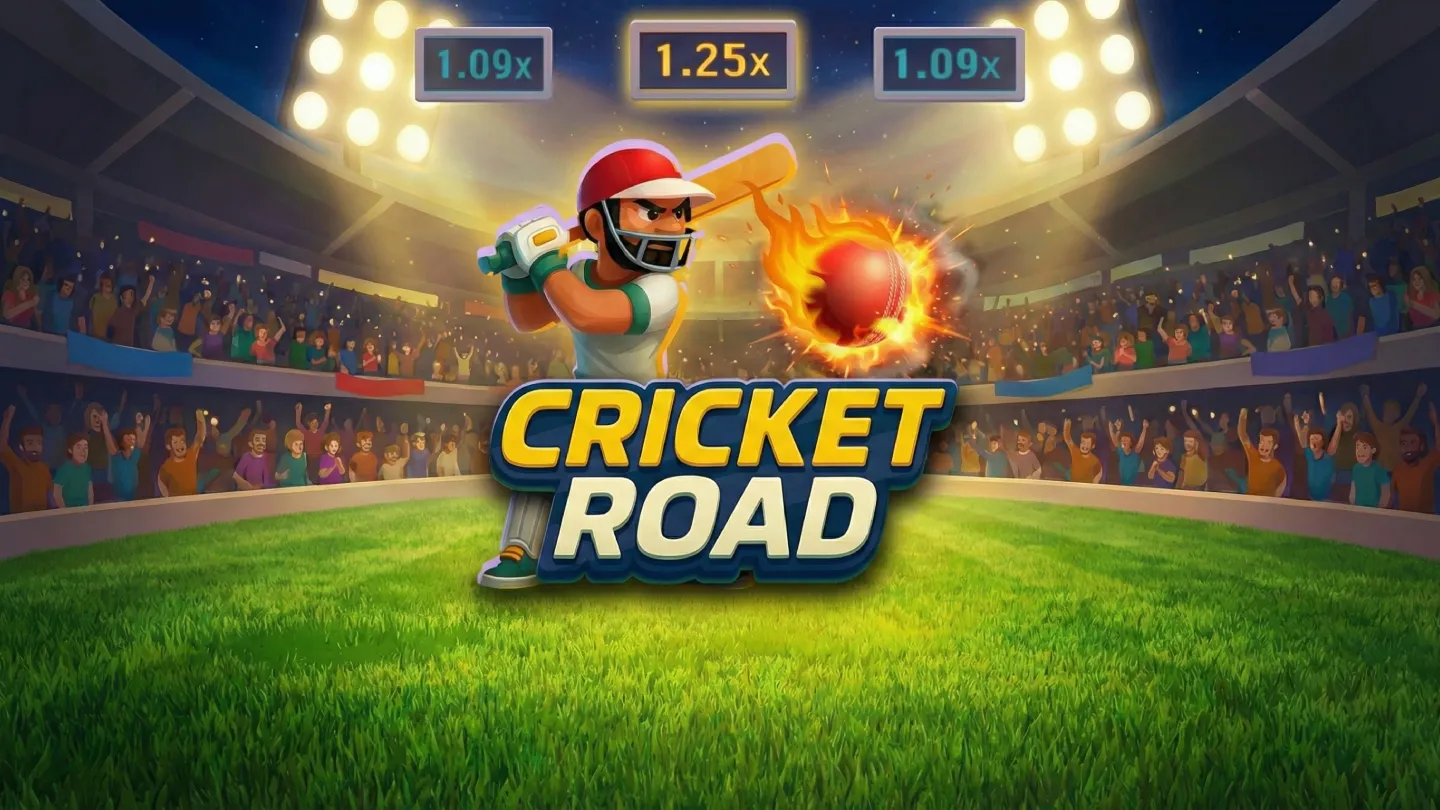
Cricket Road wraps its RNG outcome in a bat-on-ball strike animation, complete with a pause before contact and a visible swing. That presentation is deliberately built to feel skill-based, the same way a batter reads a bowler’s release. It is not. The ball flight, the bat contact and the runner’s advance are visualization layered on top of a result that was already decided before the animation played. Believing that faster reflexes or better timing change the outcome is one of the most common misreadings of this entire genre, and it is exactly the gap that predictor sellers exploit.
Does a Cricket Road predictor actually work
No. Predictor apps and signal channels built around road-style games claim to know which strike will miss, and every single one of them is a scam. That is not a hedge, it is the mechanical reality of how the game is built. No external tool has access to the game server, and the provably fair system exists precisely because outcomes are fixed cryptographically before the round starts, not readable in advance by anyone — not by the operator’s own staff, and certainly not by a downloaded app.
What provably fair actually proves
The settings panel shows a server seed hash before each round begins. That hash is a cryptographic fingerprint of the result that has already been locked in server-side. After the round resolves, you can take the revealed seed and run it through any SHA-256 calculator to confirm the outcome matches what was committed beforehand. This system proves the opposite of what predictor sellers want you to believe: it proves the result was fixed before your bet was even placed, which means there was never a window in which a signal could arrive early enough to matter. If a predictor genuinely worked, it would mean the provably fair system was broken, and there is no evidence of that anywhere in this game or the wider InOut Games portfolio.
Why a predictor could never be legal or licensed
Asking whether a Cricket Road predictor is real or fake, or whether it is legit, misses the more basic point: no licensed version of this claim could exist. InOut Games runs Provably Fair cryptographic verification as the core technology across its entire portfolio, and the software is certified against regulatory requirements in multiple gaming jurisdictions. A tool that reliably predicted RNG outcomes would represent a certification-breaking exploit, not a consumer product sold through an app listing. Every predictor claiming legitimacy is trading on the gap between how the game looks and how it actually runs.
Signals, streak patterns and the belief that history predicts the next strike
A large share of predictor marketing leans on “signals” — supposed patterns in past rounds that flag when a miss is due. This taps into a very human instinct: after five clean hits in a row, it feels like the next ball is either overdue for a wicket or somehow due for another hit. Neither feeling has any basis in how the math works.
Why past strikes tell you nothing about the next one
Each strike is an independent random event. The RNG does not track history, does not owe you a miss after a hot streak, and does not owe you a hit after a cold one. The multiplier ladder is risk-priced: bigger tile multipliers on Hardcore exist precisely because the probability of a miss is higher on that route, not because the game is building toward a scripted outcome. Treating a run of hits as a “signal” that the next strike carries better odds is a misunderstanding of independence, and it is the exact misunderstanding that predictor products are built to monetize.
The RTP number a signal service can never beat
All four difficulty modes return the same 95.5% RTP. That figure is fixed across Easy, Medium, Hard and Hardcore — the modes change variance, meaning how swingy your results feel, but none of them change the long-run house edge. Over enough rounds, the game keeps roughly 4.5% of turnover regardless of which mode you play or which signal service you follow. No pattern-reading, no timing practice and no external alert changes that percentage, because it is baked into the probability distribution behind every tile, not into anything visible from outside the server.
Cricket Road hack claims, mod apk files and algorithm myths
Beyond predictor apps, a related family of claims circulates around Cricket Road: hacks, modified APK files, and talk of cracking the game’s “algorithm.” These deserve a direct answer because the risk they carry goes beyond losing a bet.
Why there is no official app to hack or mod
Cricket Road is an HTML5 game that runs directly in mobile browsers and inside casino apps carrying the InOut Games portfolio. There is no standalone Cricket Road application to download in the first place. APK files and app-store listings offering a standalone “Cricket Road” app are not official products — the real game exists only as an in-browser or in-casino HTML5 client. Anyone offering a “mod apk” is distributing something that has nothing to do with the actual game engine, which means it cannot alter odds it never touches, and it may instead be malware wearing the game’s name. If you want the real client on a phone, the safer route is checking how Cricket Road runs across Android, iOS and desktop browsers rather than sideloading anything.
What “cracking the algorithm” would actually require
Talk of reverse-engineering Cricket Road’s algorithm assumes the outcome logic is exposed somewhere a player could study it. It is not. The RNG process runs server-side, seeded and hashed before you ever see a round, and certified under regulatory requirements in multiple jurisdictions. Nothing about the client-side animation — the bowler’s run-up, the bat swing, the tile path rendering — carries the underlying probability data. There is no algorithm to extract from watching strikes happen, because the visible game and the mathematical engine behind it are deliberately separated.
What you can verify instead of chasing a predictor
The honest alternative to predictor promises is not another shortcut — it is knowing exactly what is fixed and provable, and treating everything else as genuinely random.
The fixed facts worth knowing
- RTP sits at 95.5% across every difficulty mode, with no mode offering a better long-run return than another
- The multiplier ladder tops out at a fixed x3,608,855.25 on the hardest route, openly displayed rather than hidden behind a random jackpot mechanic
- Betting runs from $0.10 to $100 in typical configurations, with some setups allowing $0.01 to $200
- Four modes stretch the tile path from 18 to 30 steps, and cash-out is available after every successful strike
- Money you cash out is locked and safe; everything still in play remains fully at risk on the next ball
That list is the entire scope of what is knowable in advance. Everything else — whether this specific strike lands or misses — is random, full stop.
Using the demo instead of a predictor subscription
The official demo is the only legitimate simulator for this game. It runs the identical math with play money, letting you feel the rhythm of each difficulty mode, watch how fast Hardcore can end a round, and get comfortable with the cash-out button under no financial pressure at all. Spending time there tells you more about how the game actually behaves than any predictor ever could, because it shows you real outcomes generated by the same system, rather than fabricated “signals” generated by someone selling a subscription. If you want to see the mechanics and controls laid out step by step before wagering anything, the how the game is played breakdown covers the stake selector, difficulty picker and cash-out flow in full.
Where discipline actually replaces prediction
Since no tool can tell you the next outcome, the only lever left in your hands is how you manage stakes and cash-out decisions round to round. Setting a target multiplier before you press GO, matching difficulty to what you can afford to lose outright, and keeping bets flat instead of chasing losses are the only practices with any real effect on your session — not because they change the RNG, but because they change how you behave around it. That kind of structured approach, not a predictor subscription, is what separates a controlled session from one that spirals. For a fuller rundown of these approaches, staking and cash-out discipline is covered in more depth elsewhere on this site.
Cricket Road’s entire tension comes from not knowing what the next ball does, and that uncertainty is the product, not a flaw to be patched by a third-party app. Every predictor, every signal channel, every claim of a cracked algorithm is selling certainty that the provably fair system was specifically designed to make impossible to fake. Treat the RTP, the ladder, the bet range and the cash-out mechanic as the only facts on the table, play within limits you have set for yourself, and leave the rest to the randomness it actually is.